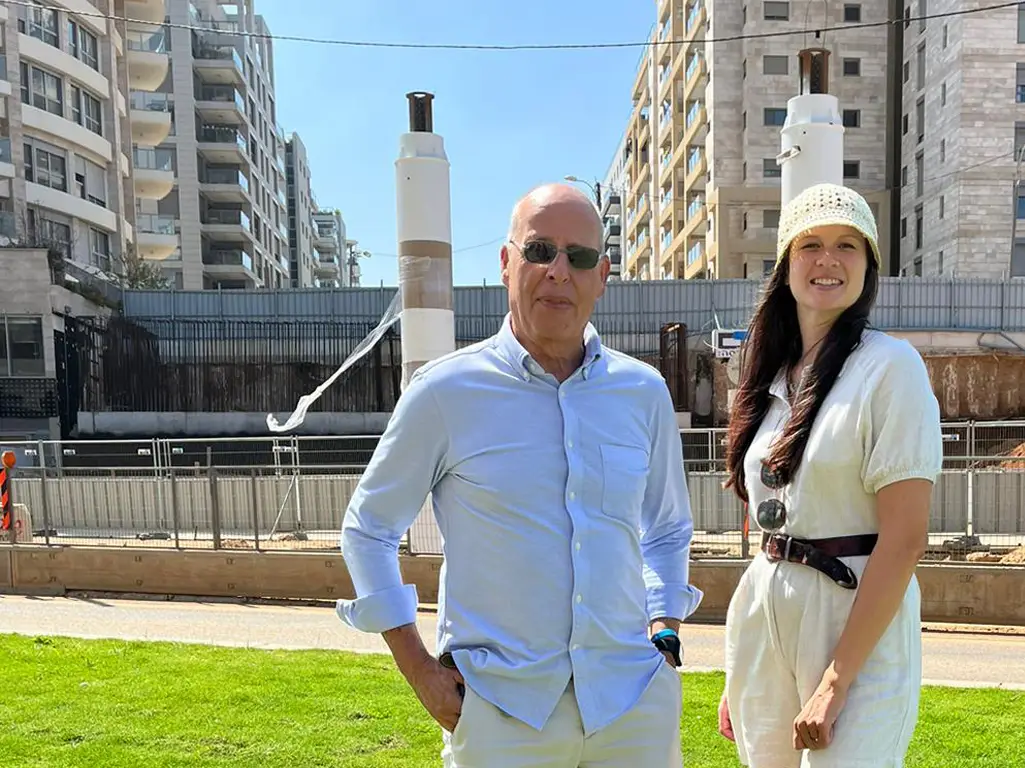
Generations in Dialogue: interview with architects Yoav Messer and Nelly Skomorovsky.
Yoav Messer and Nelly Skomorovsky are architects with many years of experience and a recognizable design language. Yoav is the founder of Messer Architects, and Nelly is the studio’s lead architect. Together, they work on projects where architecture becomes a form of dialogue with the city, its history, and its evolving context.
We met with Yoav and Nelly in their studio to talk about the challenges of contemporary architectural practice, the specifics of building in Israel, the studio’s approach to historical preservation and international collaborations and whether their views always align or occasionally diverge.
Yoav, Nelly, could you introduce yourselves briefly and tell us a bit about your backgrounds?
Yoav: I’ve been working in this office for the past 35 years, sitting right here where I am. These photos behind me are part of my background.
Here is the President of Israel, Shimon Peres, I designed this building for him. Here is my father, who was a colonel in the army during the War of Independence. This is another Prime Minister of Israel, Yitzhak Rabin, together with Igor Danon and Igor Ledin. Behind me, you can also see a framed document – a corner piece of the Peres Peace Center, signed by Bill Clinton, the Mayor of Tel Aviv, and many other very important people.
Nelly came into our lives with a new spirit. Over the past nine years, step by step, she has become an excellent architect, thanks to her character, talent, and the way we’ve managed to work together. It’s something that didn’t happen with others before – not something common.
So I think it is important to understand what we’re doing in our architectural work, and how we coordinate between two spirits, two generations, even two languages and as a result develop outstanding projects together.
Nelly: I hope this conversation will be helpful to newcomers. I was lucky to have a wonderful professional experience here, and I’d love to help others build their careers in Israel.
I’m originally from Irkutsk, Siberia, where I studied architecture for six years. After spending a year in Manchester, I decided to make Aliyah and arrived in Israel in November 2016.
Finding a job was my top priority. I felt stressed as I had lost a year, while my classmates were already working, and I wanted to return to the field quickly. Through the MASA program, I visited several offices, but Yoav’s felt right: demanding, professional, and warm at the same time.
I started my internship just a week after arriving, with no Hebrew. The first day was overwhelming: my computer was entirely in Hebrew, and I didn’t even know how to open folders! I drew symbols in my notebook just to navigate the system. My first task was to design a shelter – something I had never learned at university!
However, the team supported me enormously. I attended weekly meetings, writing Hebrew words in Cyrillic and then asking colleagues afterwards what they ment. About a year later, I realized I could finally follow the conversations. And then one day, I understood everything and could finally take part in the discussions.
We understand that teamwork is important in your studio. How do you build your working process?
Yoav: We work in four stages on each project.
First of all, we gather all the data. We examine the site, its context, the client, and the surroundings. I believe that the most important aspect in Israel is the cultural foundation of every project. This is what makes it different from other places. It’s not like what we did in Belgrade, for example, or in Italy. You need to study and learn continuously, collecting all the data, including regulations, rights, and so on.
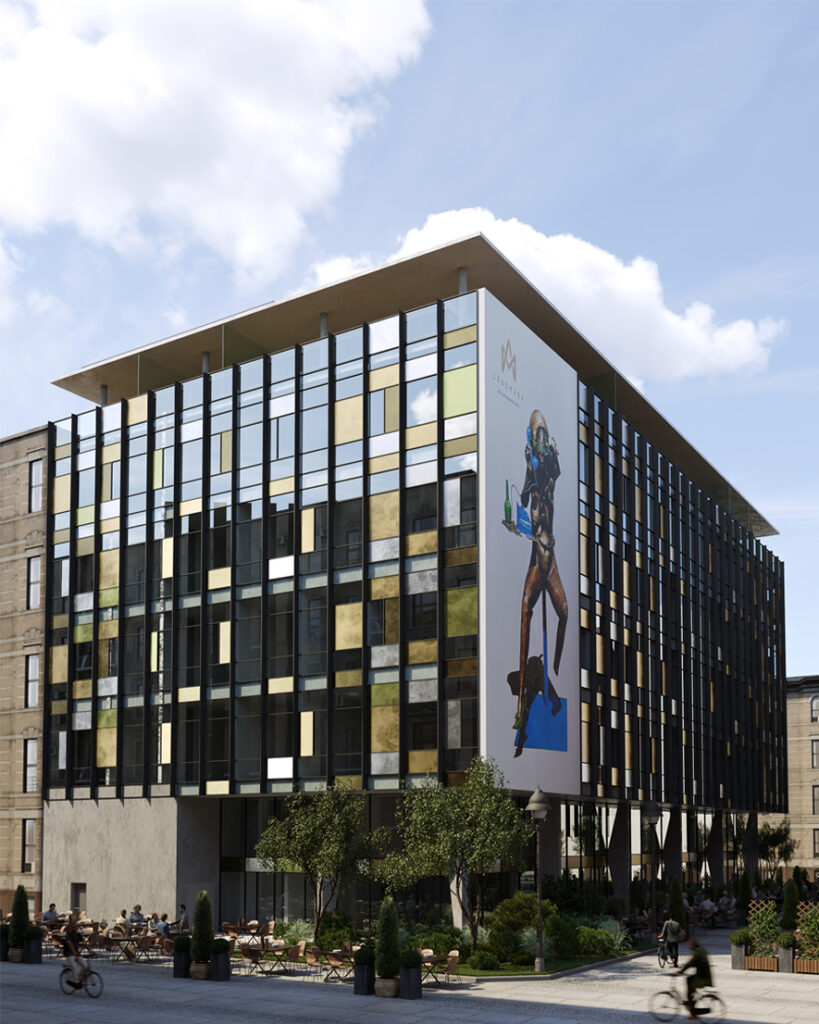
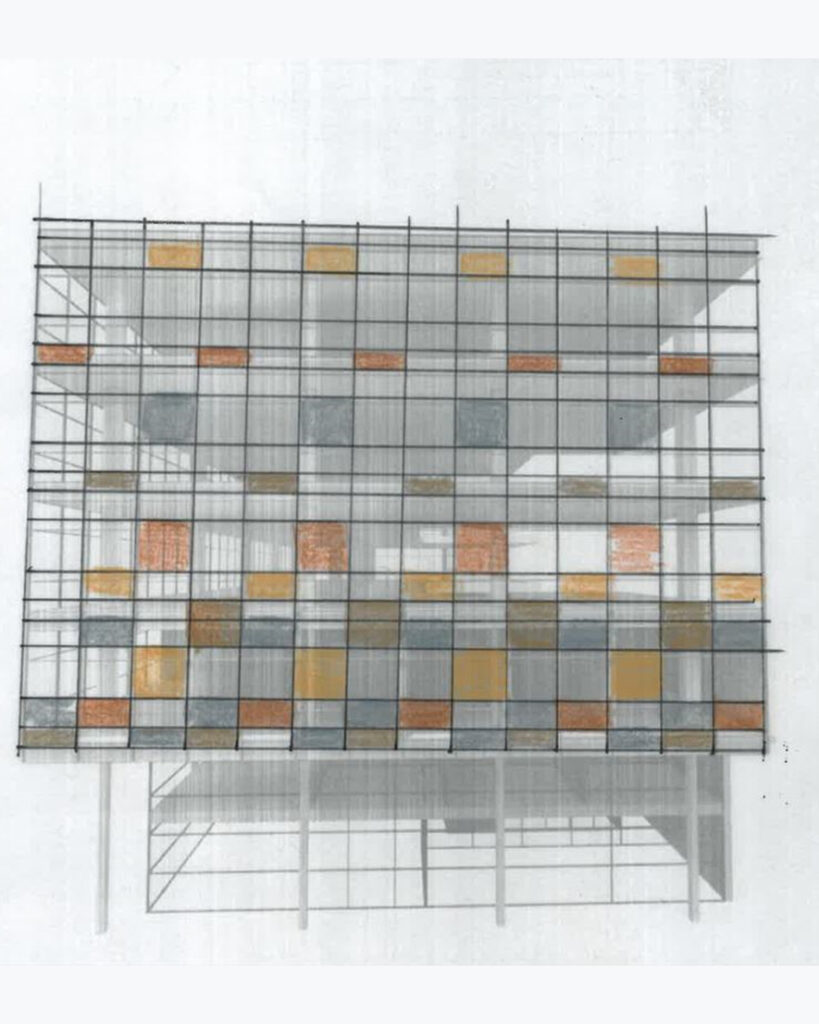
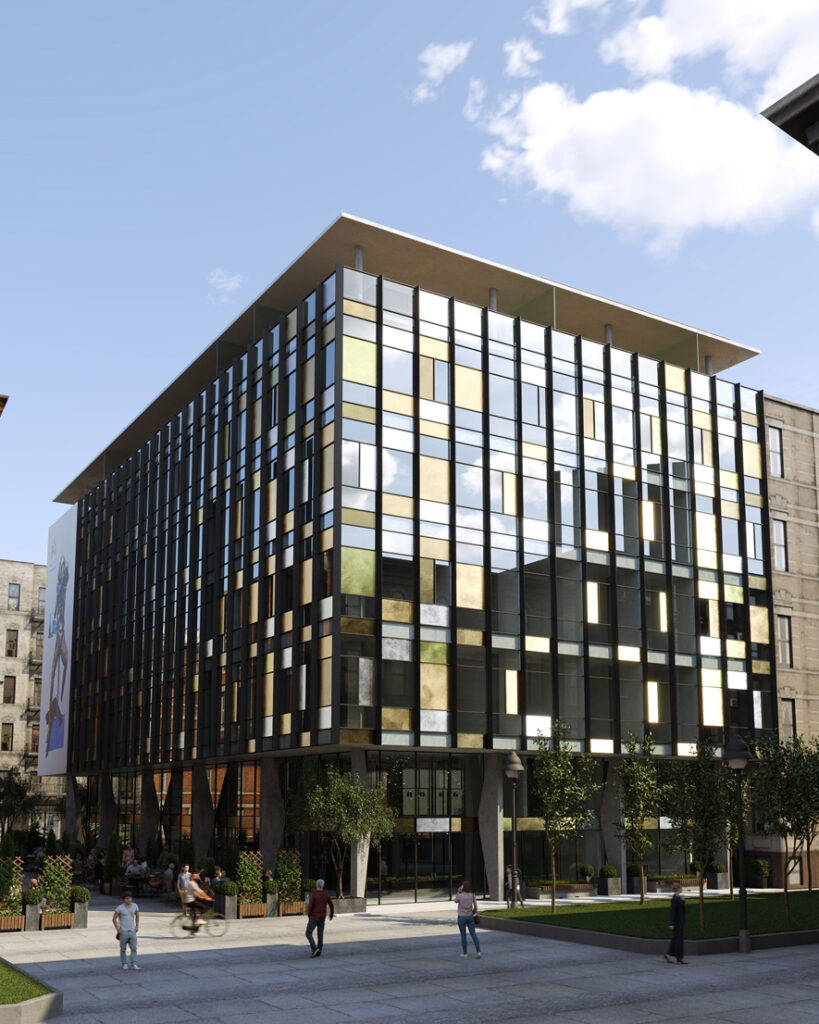
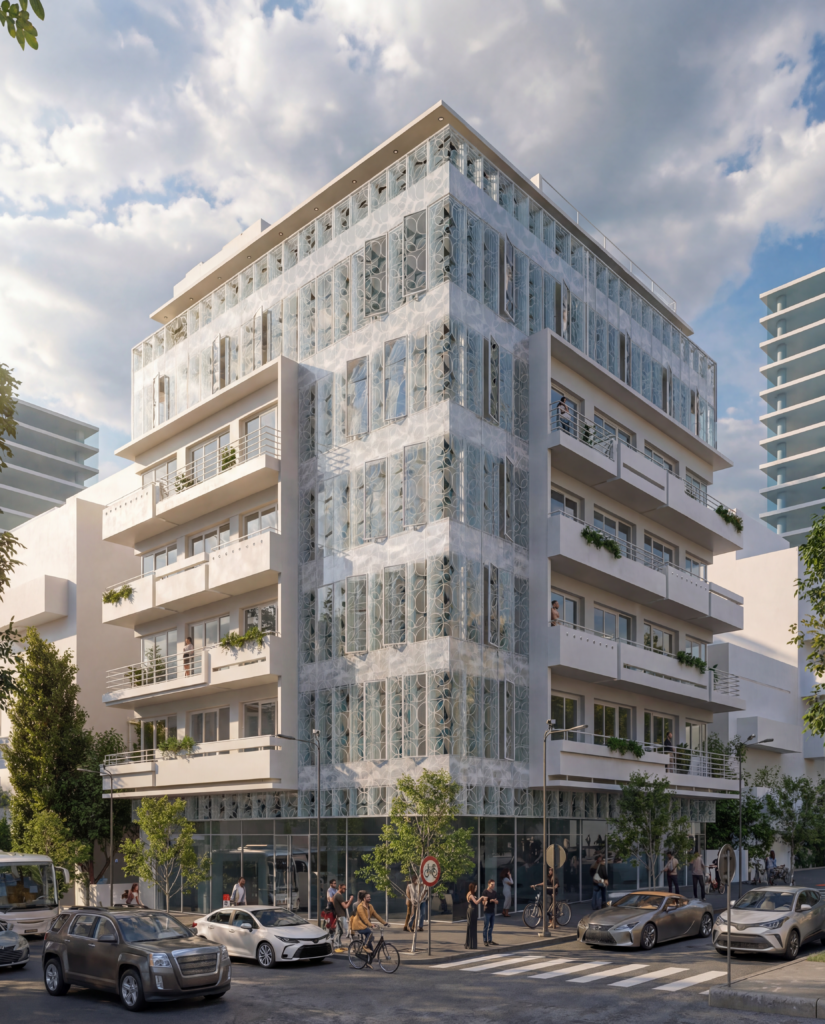
Then we move on to developing the concept – the story behind the project. This is where Nelly comes in, as she’s very good at it. Together, we develop usually at least three concepts. Right now, she’s working on the new façade for a boutique hotel in Tel Aviv and it’s never just a single idea. We can show you another project where we developed 25 or even 30 different façade options because it was so complex. If something works, we keep it. If not, we move on. For example, in the Rothschild project, we eventually found the right solution and both felt that it was the right choice.
Once the concept is developed, we move on to the design stage. That includes all the drawings for execution, and finally, site supervision.
Nelly: I would say that about 80% of our time we spend on documentation and of course, that’s the part we enjoy less of all. But when it comes to the process, I think what really helps is that we already know each other very well and understand each other’s strengths.
For example, I know that Yoav is amazing, definitely better than me, when it comes to planning. He has a stronger vision for that. I believe my strongest skill is design. So usually I don’t start with technical constraints or initial limitations – instead, I look for inspiration somewhere outside and try to bring that into the concept, always in connection with the specific site and its context.
Also, in many projects we work as a team, not individually. Each of us brings ideas, we test them, and in the end, one project can include several different ideas that evolved through this process. So it’s a real teamwork!
How many people work in your office, and how do you manage big projects with a small team?
Yoav: We are eight people total: five to six here, two in Italy, two in Belarus. We work efficiently with consultants. Projects may be huge, but our small, well-organized team handles them successfully.
Nelly: Teamwork is essential. This summer, for example, we traveled together on project visit to Italy, collaborated and shared responsibilities. However it rather felt like a trip with clothe friends!
Can you walk us through your creative process – from the initial idea to the final realization?
Yoav: First, we do sketches and models to explore potential. For example, in the Belgrade project, sketches moved to Nelly’s table and developed into the facade and presentation in one and a half months. In the Rothschild project, we explored about 20 alternatives before deciding to base the design on Bauhaus heritage.
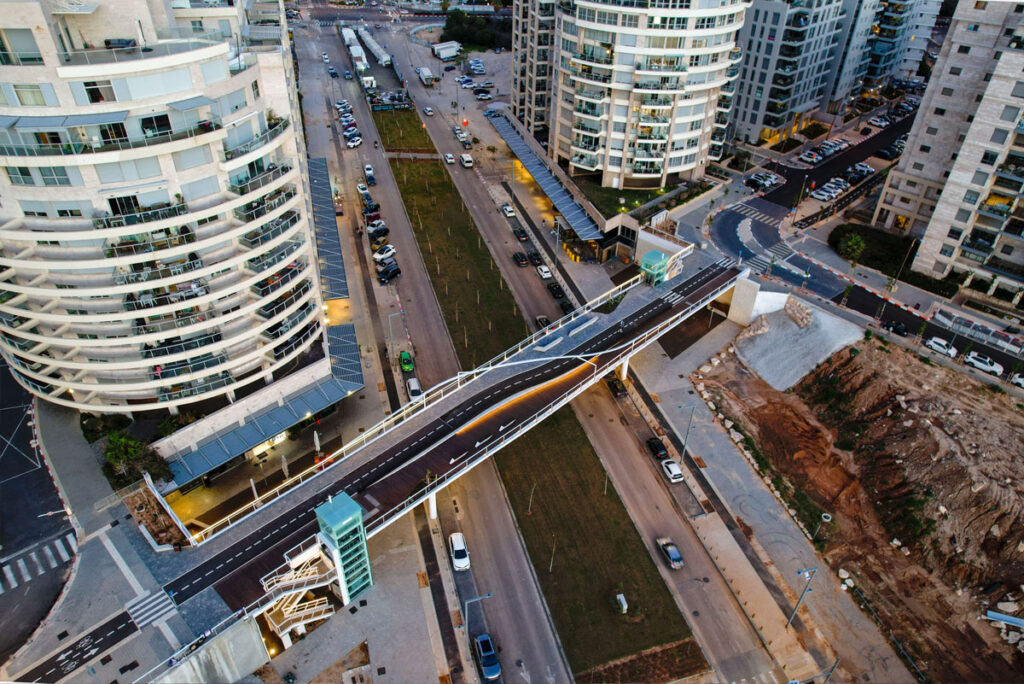
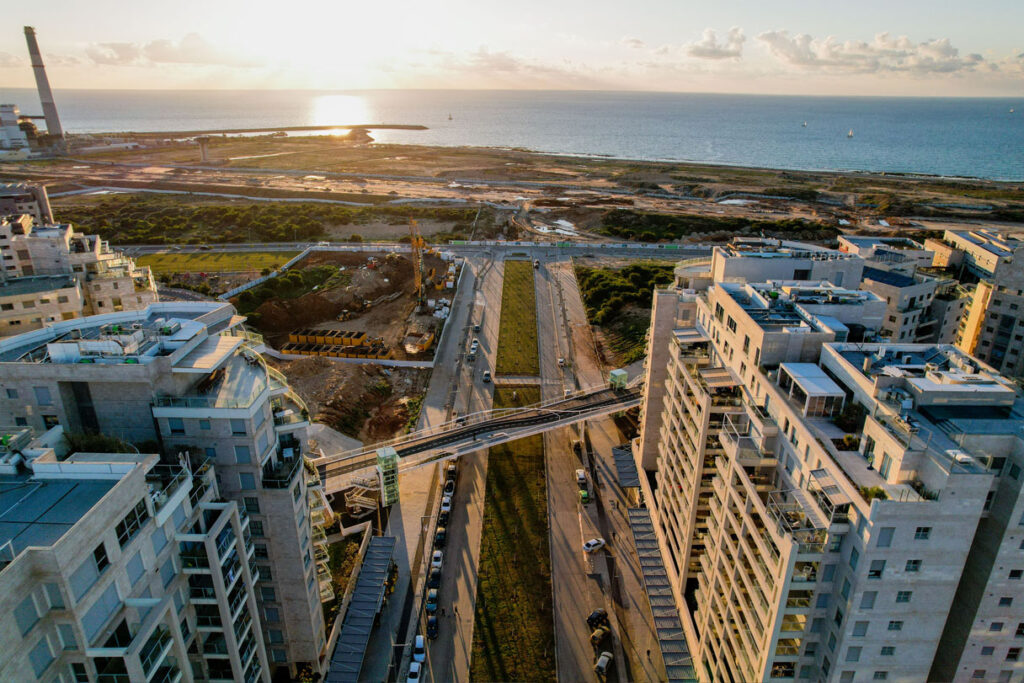
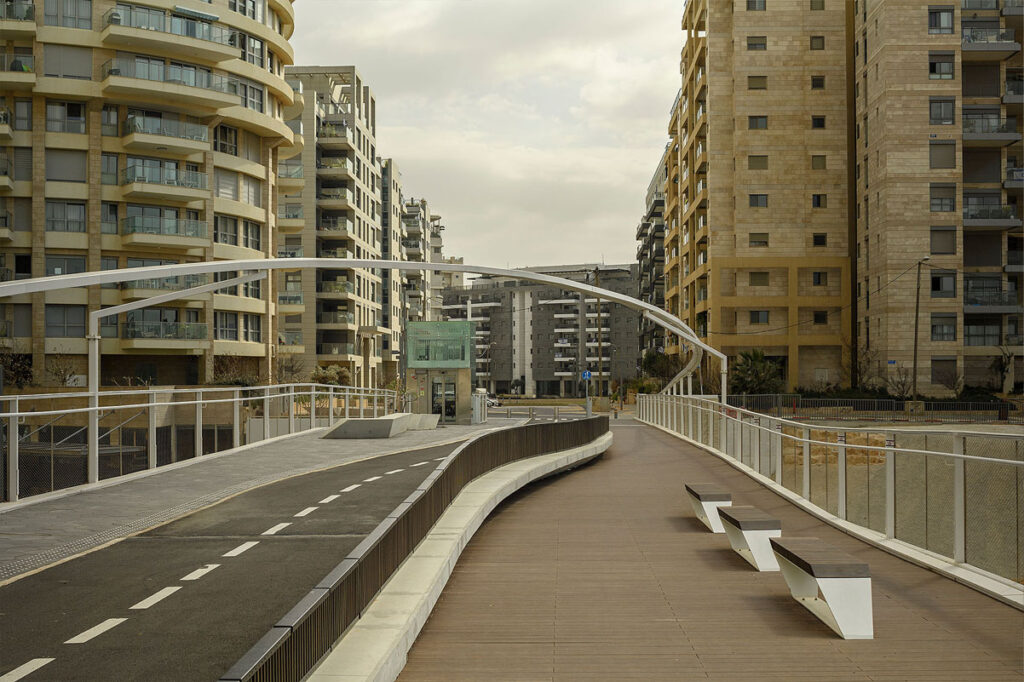
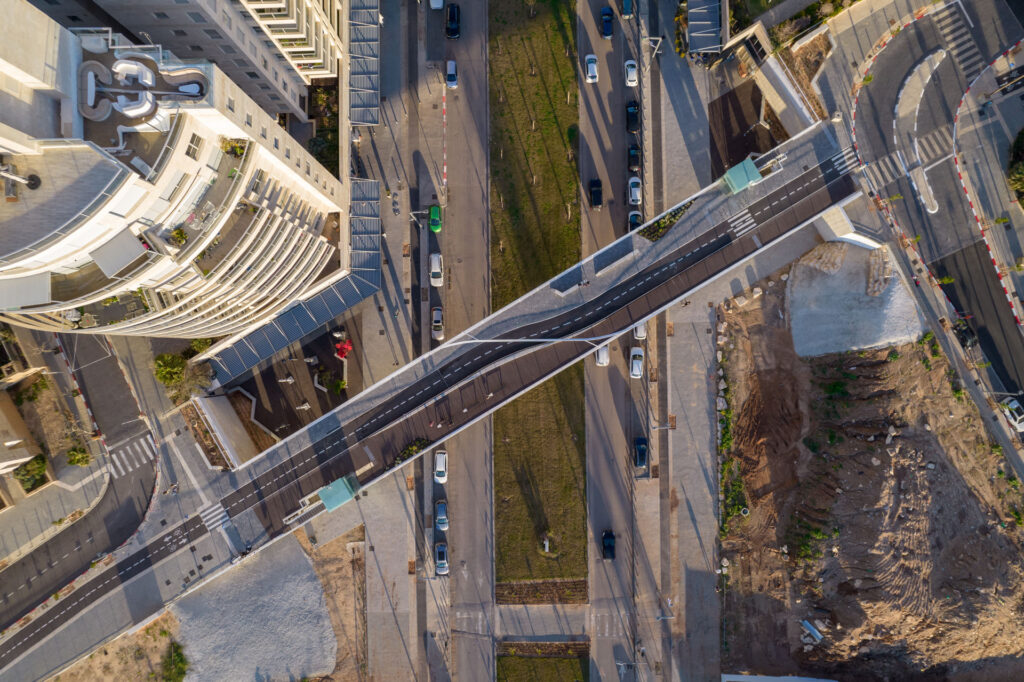
Nelly: The concept stage involves integrating multiple perspectives, including site, client, and technical feasibility. For example, the Einstein Road bridge in Tel Aviv integrates multiple ideas: levels, bicycle paths, elevators inside the bridge.
Yoav: The whole process takes years. Like, for example, if it’s a real project like Rothschild Hotel. I think we started in 2017 and we hope to get a permit in about one or two months, and only after we get the permit we will go to the next stage, which is a tender. So it’s a long way.
Can you give an example of concept development?
Yoav: So this is the Rothschild project, the one where we prepared around 20 different alternatives. Somehow, none of them felt quite right. The location is on Rothschild Boulevard, right in the heart of Tel Aviv, and I think it was your idea, Nelly, or maybe mine, not to invent something completely new or crazy, but instead to take the Bauhaus heritage as our foundation. What we understood is that this site carries the history of Rothschild Boulevard, and all the original facades of the historic buildings, so we built our concept around that.
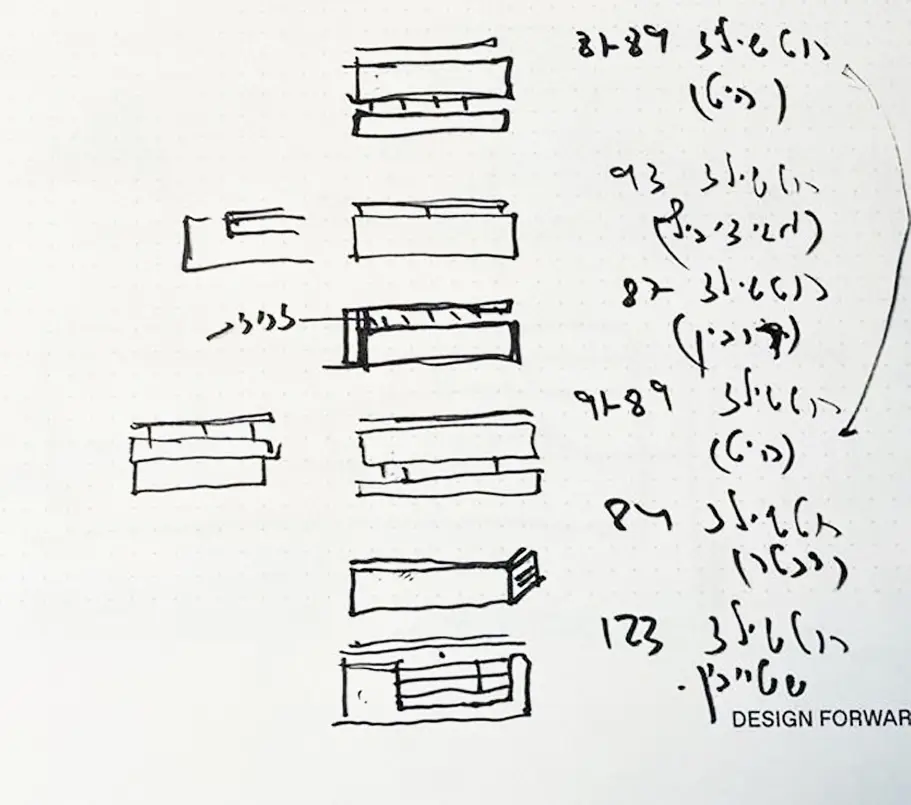
We created a collage of different balconies from Tel Aviv’s historical buildings. Look, this is like a catalogue of all balconies from those Bauhaus buildings. The concept is very simple: glass is broken up by balconies. Then we developed the façade and added a special glass element with a Bauhaus-inspired print. We wanted to create a building that could exist only on Rothschild – you can’t take it anywhere else in the world.
So when guests of the hotel step out of their rooms, they immediately feel: I’m here. They see that the architecture of this or that balcony was part of Tel Aviv’s history. But it’s not kitsch. It’s a contemporary interpretation. You see the contrast between black and white.
How does the concept of the building’s exterior translate into its interior design?
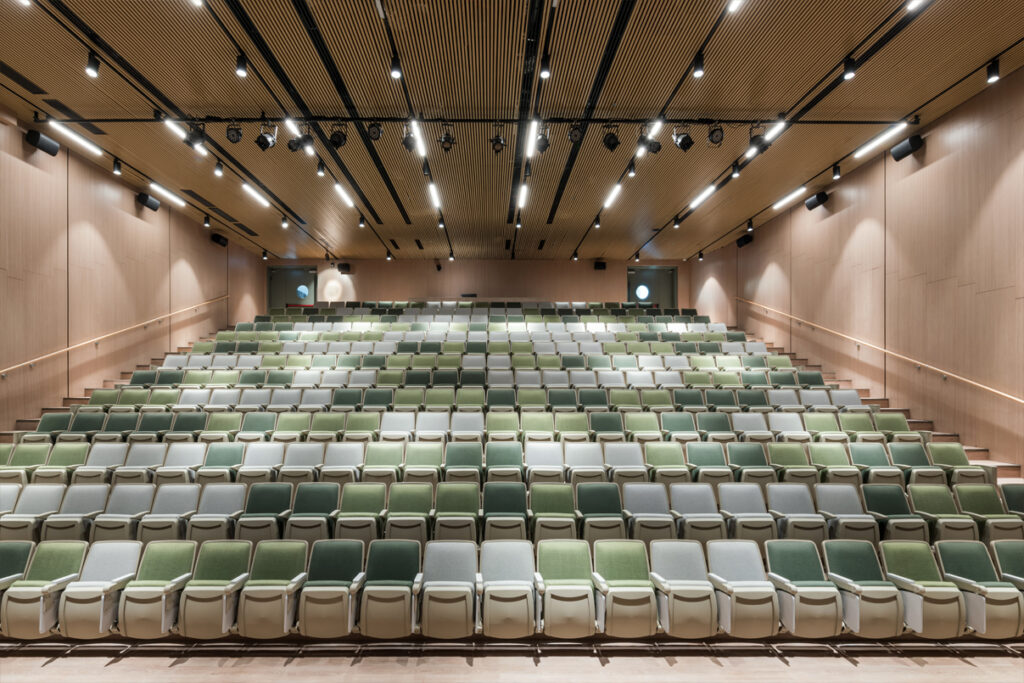
Yoav: Let’s take a look at our project of a school building in Herzlia. From the very beginning, we knew we wanted to create a green, living building, that would truly breathe. And now we can see the result: the plants are growing all over the structure – on the roof, around the entrance, climbing the facades.
We were also responsible for the interior design. Nelly prepared the first model, but at the start, we weren’t sure how it would work structurally. It was an interesting challenge – to make sure the columns didn’t touch each other, but could intersect and connect as part of a 3D ring wrapping the building. Some columns start from the outer corner and continue inside. We have plants on the roof and more greenery climbing behind the ring. Today it’s completely covered in vegetation.
When we moved to the interior design, we tried to keep the same dialogue between exterior and interior, where one ends, the other begins. This wall, for instance, was designed by our interior designer Noa. It’s made of rammed earth – sand and real soil. It becomes part of that natural transition: you step inside, and the material from the outside follows you.
We also covered the interior corridor walls with different tiles. Then came the furniture, the chairs, the glass – everything designed to speak the same language. This table, for example, we designed ourselves and it follows the same rhythm as the façade – simple, clean, and structural. Each table and each chair has its own tone, yet everything remains in harmony. We chose every color carefully to complete the overall palette.
We can see some physical models of your projects here in the office. Do you still build such models as you used to, or do you mostly design digitally now?
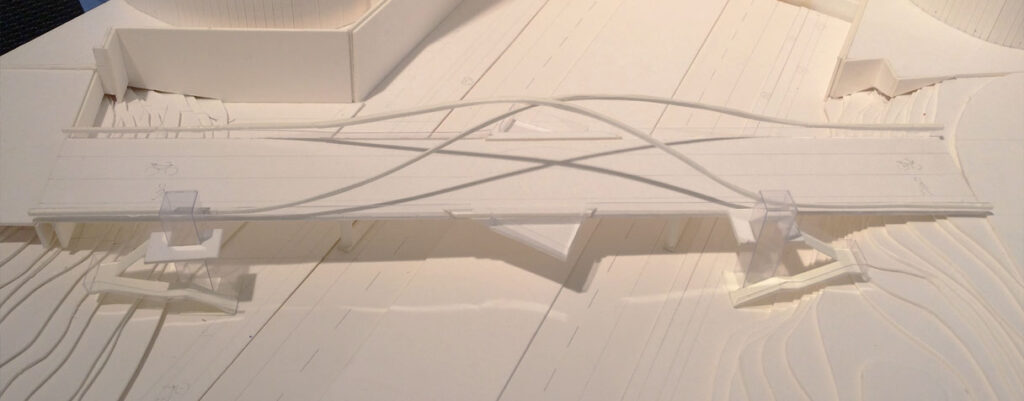
Yoav: We used to make a lot of physical models, though lately the world has changed. Now everything is about 3D models and even AI. We became a bit lazy with physical ones, but I still think they are very important – they let you really feel the project. Look at this bridge model here, for exanple.
Nelly: I want to add how the concept of this bridge was born. I remember it was in 2017, Yoav, me, and Rivka were in that room, working on ideas. My dream was to create a 3D bridge, not a flat one. I wanted it to have two different levels, so when you drive on the road, you could see through it. And I remember, it was your idea, Yoav, to twist the bicycle path to create a wider area with space for benches on both sides. And also, you suggested placing the elevators and stairs inside the bridge, not outside.
Yoav: So in the end, this project became a mix of all our ideas. It’s located on Einstein Street in Tel Aviv, named after Albert Einstein, the famous genius. We took some of his principles metaphorically: moving space this way and that way to create a dynamic form. Here is the top level: when you ride your bicycle here, you can stop, look one way toward the sea, and the other way toward the city. One part is a sidewalk, another is a wooden deck. I remember it was Rotem’s idea to turn part of the bridge into a long continuous bench all along the path. It was actually my first real bridge project, and it was very exciting. The same feeling I had when I worked on the Norman Hotel, the first one I designed.
How do you feel about artificial intelligence in design and concept creation?
Yoav: We’ve seen our partners interior designers moving quite quickly with AI. Some things are very simple to do with it. But in architecture, we don’t really know yet how it will work. I believe we need to stay professional. The main problem is what we already talked about – the background, the history, the culture, the concept of the city, the urban design. These are things we simply can’t discuss with AI. No way.
Nelly: What I can add is that, for me, and probably for most architects, the favorite part is the design itself: finding the right concept, the right proportions, getting everything just right. And I really don’t want AI to take that away from us. I’m ready to use it to create perfect renders or to get more ideas. But I want the main idea to be mine. Otherwise, maybe AI could even do it better, but I don’t want to go in that direction. AI can be a fantastic tool. Still, it’s people and professionals who must guide it in the right way.
I believe that nowadays AI can suggest millions of façade alternatives that look amazing, but they wouldn’t be mine.
Yoav: Yes, it’s a question. But from what I see, both now and in the near future, AI won’t replace humans, it won’t take the architect or interior designer out of the profession. It will just provide very good tools – rendering tools, administrative tools, and basic ones to help with the process.
What advice would you give to young architects or architects who moved to Israel and are looking for a job here?
Yoav: Never mind if it’s a public building, a residence, a boutique hotel, a preservation project, or a bridge – whatever you do as a young architect, you should approach it seriously. Learn from it. Try to do what you haven’t done before. Don’t limit yourself to one field of expertise. What has saved me over the last 35 years is the ability to move from one area to another and to keep learning. I started my career designing private houses in Ramat HaSharon for some of the wealthiest people in Israel. Then I moved to public buildings, and later to hospitality. Now we’re moving toward Italy, and it’s another “language” we’re trying to develop. I don’t know where it will lead, but that’s the beauty of it.
Nelly: If I were a new architect coming to Israel, the first thing I would ask myself is what kind of architecture I want to focus on. Because in Israel today, there is a bit of everything. When I came, I already knew that I loved working on public projects, not just residential ones. That’s one of the reasons I joined Yoav’s office – he had many projects of that kind. But if you look at where most of the work is now, it’s definitely in residential architecture. You can see it everywhere, even where I live, in Ramat Gan, every single building is being renovated. The same goes for Tel Aviv. And I believe that in the next 10 or 20 years, this trend will only develop. I’ve never worked on villas, as Yoav, but I think there will always be wealthy clients and private homes to design.
Yoav: Look, I used to design many villas, but then I realized that I was really working for just one family. Maybe a few guests would visit, but that’s about it. It didn’t feel significant. I started feeling that, as architects, we can have a greater impact on the public. When we design a square, a hotel, a public building, or a bridge, the influence is much bigger. For example, the Einstein bridge transforms the whole neighborhood: before that people couldn’t cross between the two sides because of what was in between. Now, with a train running through, the impact is incredible. In contrast, designing an important villa in the wealthiest part of Israel feels more like a personal challenge rather than a contribution.
So what is your mission as an architect?
Yoav: Our mission is to have influence. Four years ago, we had an exhibition showcasing our projects from the previous years, and we realized that we had designed 24 projects here in Tel Aviv that truly changed the city. I feel very proud of that. It made me realize that this kind of impact is more important. You create something meaningful, and maybe you are the first one to do it. There aren’t many opportunities like that in the world. For me, influence means creating a good ambience and a positive environment. It’s a privilege as an architect to shape spaces that improve people’s lives, even if they don’t consciously notice it. I truly believe that the environment we create reflects on and affects people’s daily life in meaningful ways.
What does it feel like to see your designs realized?
Nelly: It’s super exciting and I still don’t really believe it. I remember the moment we opened the bridge and I was so excited that people can finally enjoy it and they can use the space. My boyfriend tells everyone, “This is Nelly’s bridge, Nelly’s school.” It’s very rewarding.
Yoav: And what is the most important, architecture can’t happen without people. My three principles – people, spirit and context – can’t happen without people. People make it happen.
Do you have tips for young architects coming to Israel?
Nelly: The fastest way to integrate is to work in an office, even as an intern. Learn the workflow, the culture, and the language. Ambition and optimism help you succeed.
Yoav: Insistence and optimistic view. If you bring this to anything that you do, you can come in an office that is not perfect, but you insist to be the best one. By the optimistic way of thinking you can move everything. A lot of people are scared that they don’t speak Hebrew. But we can manage in English. So it’s not a problem. Hebrew is an advantage.
Contacts: