Magazine
Designing with Feeling. Conversation with Interior Designer Yehuda Ben Ishay

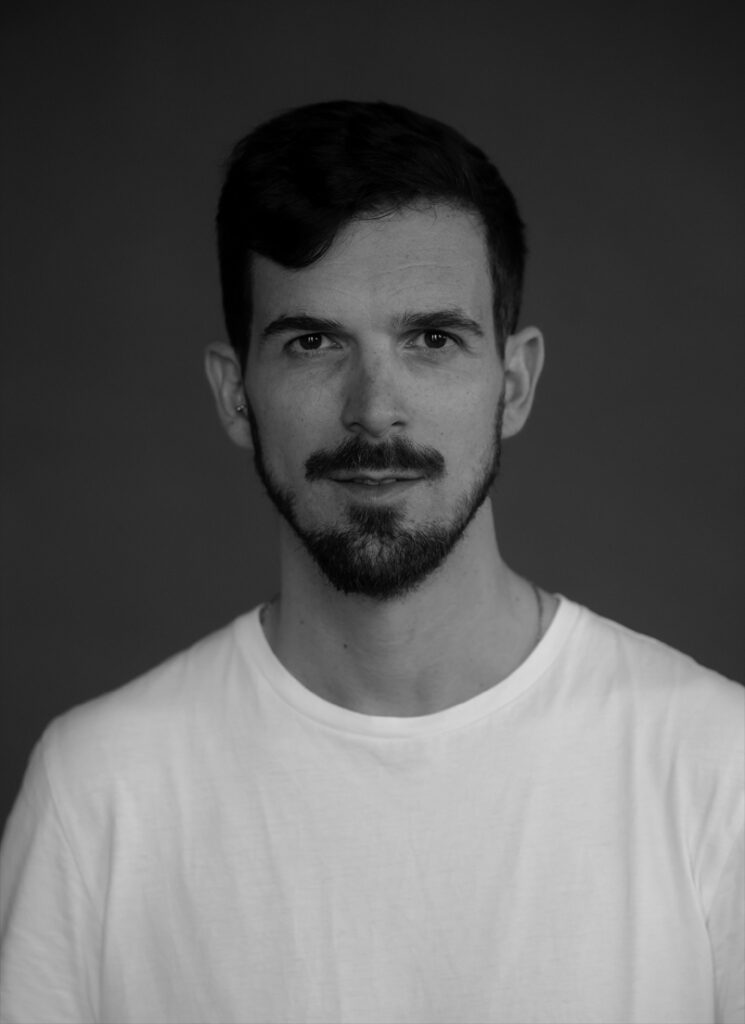
The DI Catalogue team met with architect and interior designer Yehuda Ben Ishay in his Tel Aviv studio – a warm, creative space MakomTLV. We spoke with Yehuda about the distinctive Israeli approach to space and interior design, shaped by light, material, and emotion, and about his own philosophy of working with clients, where design becomes not just a profession but a form of human dialogue.
Yehuda, lets start from the begining. Tell us what drew you to design?
I come from an ultra-Orthodox (Haredi) family. Until the age of 20 I was a yeshiva boy. But aesthetics always interested me, as well as how space affects people. I think this awareness came in a very young age. My mother is an artist and also a teacher. She was constantly creating things, so aesthetics were always part of our family life. My father also loved doing carpentry and small projects at home, so there was always this sense of creating with your own hands.
What really drove me to design was search for a sense of home. And that definition changed many times depending on where I was. Wherever I lived, I tried to create that little corner that would feel like home. I think the moment I realized I wanted to work in this field was during my six months stay in Barcelona on a mission. There I discovered architecture that fascinated me – and also interior design that was very unique. I returned to Israel, finished Kavim, a school for Architecture and Design and moved to Tel Aviv, looking for a small office to start my career. The first office that hired me was actually right here in this building, on the third floor, back when the building was still half-empty. I love this building – these lofts, the open view. It really left an impression on me and made me want to come back here.
And when did you start your own practice?
My studio has been running for about seven years now, maybe even eight. I started with very small projects. The first one I got, I just said, “Okay, I’m jumping into the water,” and started working independently. And from project to project, things grew. Each one was a small step up in exposure and experience. Every year, the number and quality of projects grew, as well as my own confidence.
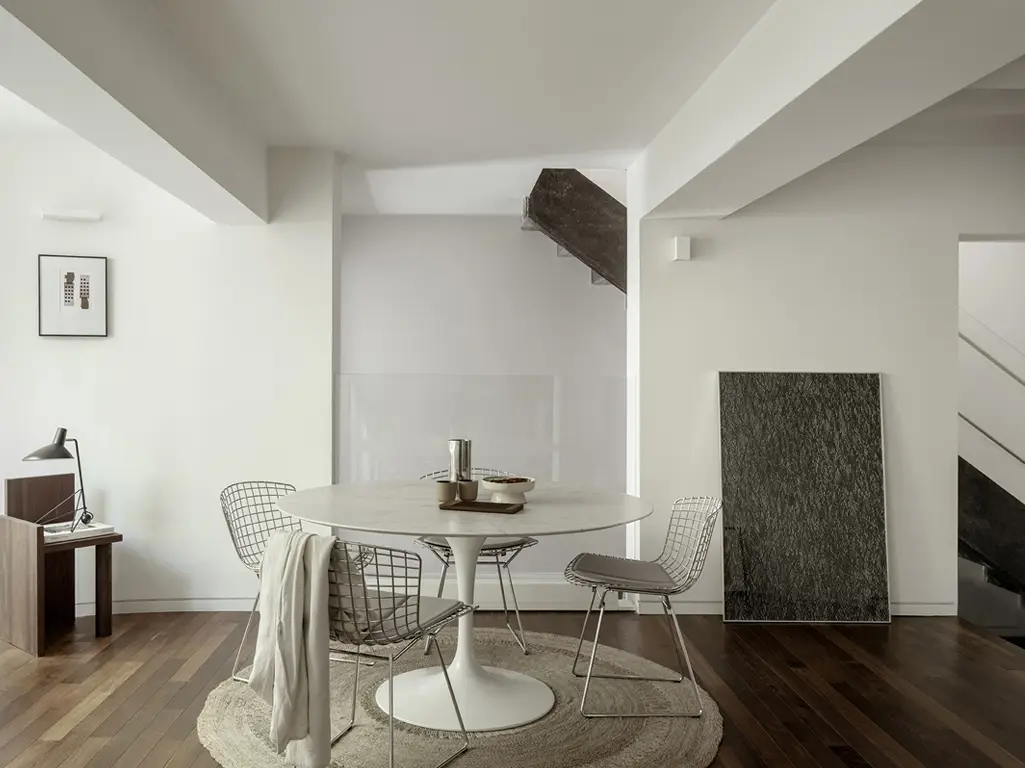
Studio by Yehuda Ben Ishay, Photo by Gidon Levin
Most of your projects are residential, and we know that’s it not easy to make the client happy. What is your secret for success?
Yes. I really love residential design – the rhythm, the people, the intimacy of it. That’s what interests me the most. I’m very drawn to the psychology behind this work, especially when it comes to couples making decisions together.
I think the secret in this case is to give each person their space. Because within one home, there are so many decisions to make and everyone cares about different things.
Sometimes it’s not even about the choice itself – it’s about not wanting to feel like only you decide. So you say: “Okay, you choose the countertop, and you choose the stone.” Or maybe one cares only about the barbecue on the balcony, and that’s enough for him, the rest doesn’t matter.
Sometimes it’s also about financial stress – one of the partners is more anxious about budget. So you have to really dive deep to understand what’s behind each reaction.
The final result is beautiful and emotional, but it’s the process that’s truly meaningful. And honestly, that’s what gives me the greatest satisfaction.
Yehuda, what are your core values in your work?
I think the most important value for me is to make people feel good. To improve what they have today, to help them create a space that makes their lives better. To look back and see what didn’t work before, and move forward with more awareness. So on the most basic level, it’s about kindness – doing good. But it’s also about improving the quality of life through materials, thoughtful planning, and a pleasant, satisfying process. That’s what it’s all about for me.
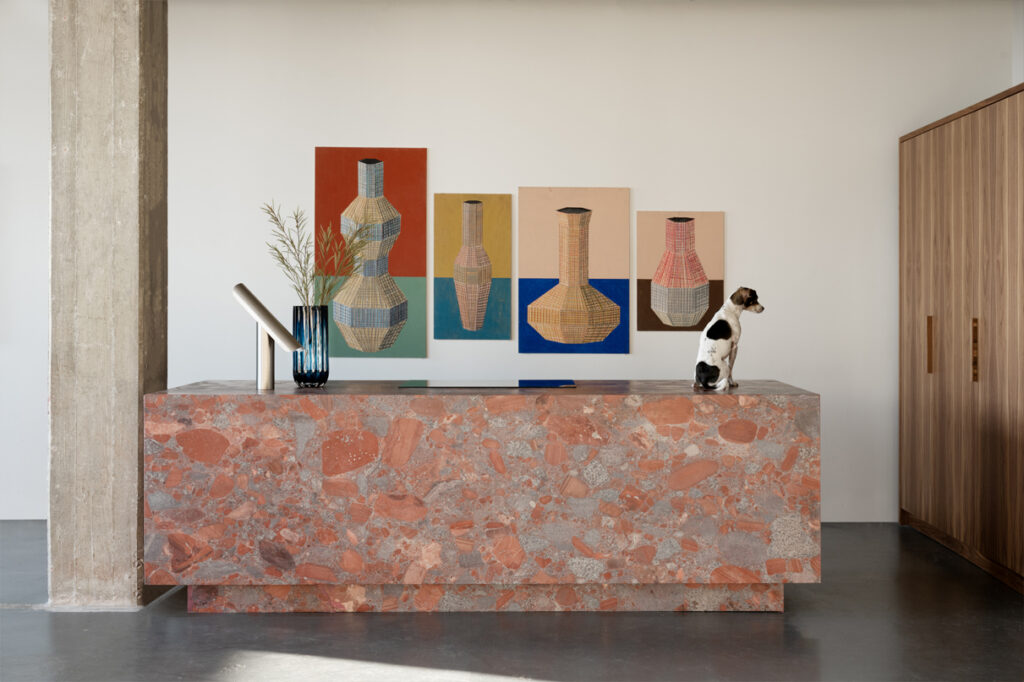
Renovation of a 4-room apartment, 120 sqm, located in a bulding built in the 1950s, Tel Aviv. Photo by Shiran Carmel, Art by Tali Benbassat
When you start a new project, what’s the first question you ask yourself or your clients — the one that defines the beginning?
Usually, after the first meeting, which I like to do in their current home, I already have a sense of who they are, what works for them and what doesn’t. The question I love to ask at the end of that meeting is: “If there were no limits – no budget concerns, no fears – what would you do?” What’s your dream without fear or restriction? The answers show me where they truly aspire to be. Because our fears are what hold us back.
And if you realize the dream they describe isn’t fully achievable — do you still try to bring some part of it in?
Exactly. Maybe we can’t make it exactly like their dream, but we can bring in pieces of it. Because often, when people say, “I want a home like that,” and we dig deeper, we discover that what they really love is one specific table, or the atmosphere – not the whole picture. So the process becomes about identifying those emotional anchors – the few elements that evoke that feeling – and recreating them. That’s what turns the design into a kind of emotional research.
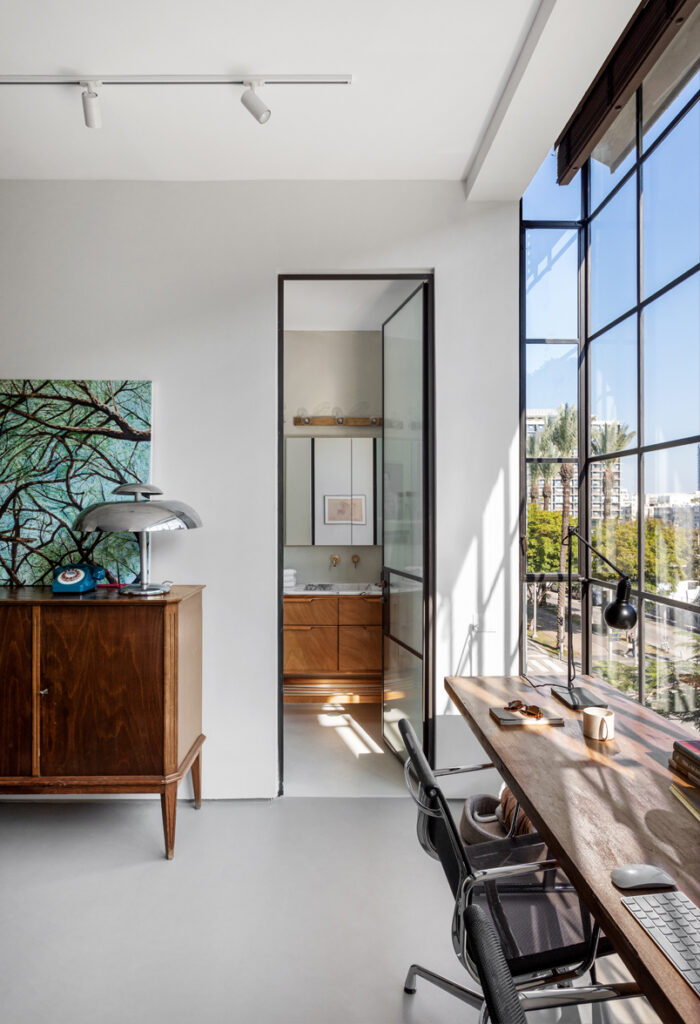
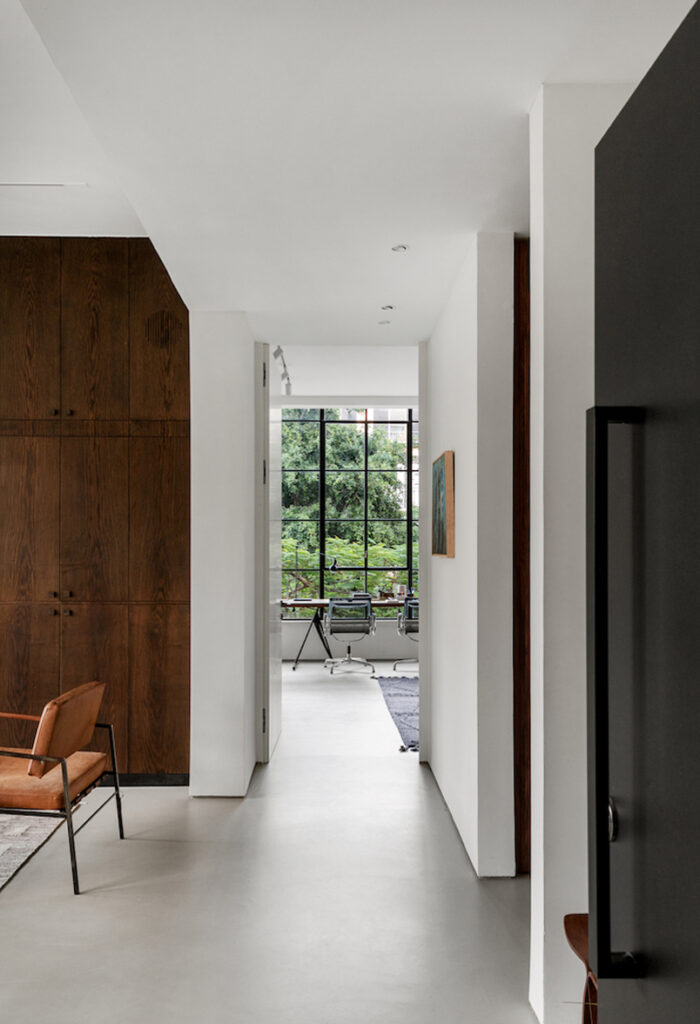
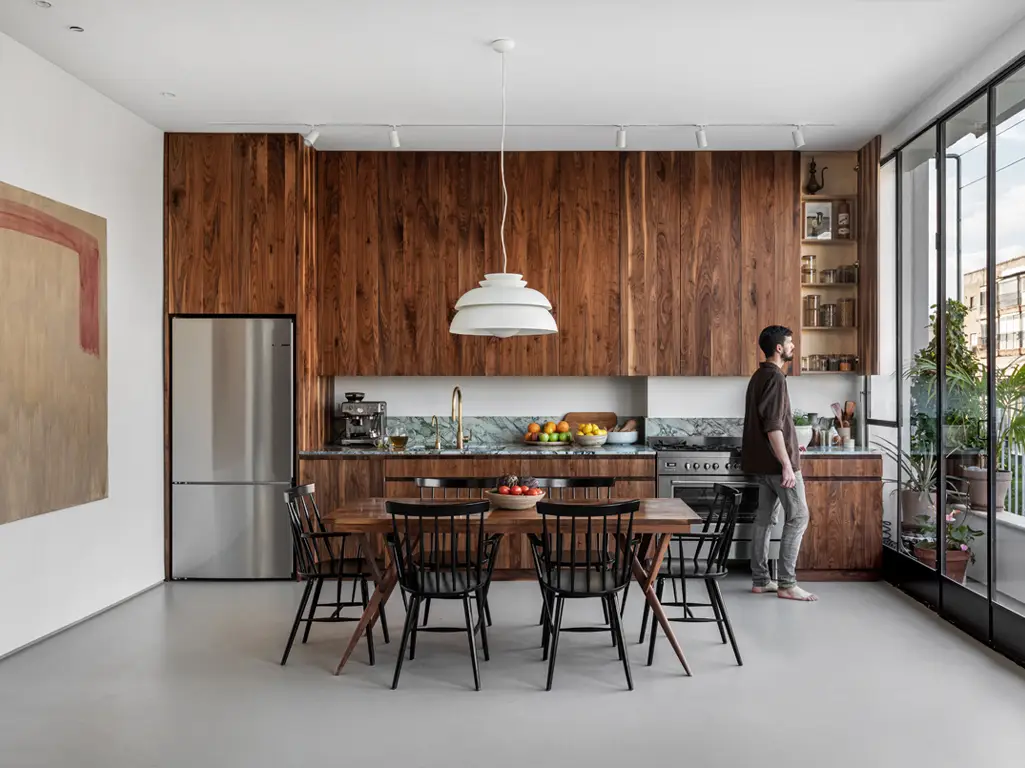
Renovation of a 4-room apartment, 120 sqm, located in a bulding built in the 1950s, Tel Aviv, Photo by Shiran Carmel
You often work with historical buildings, and yet your design language is very modern and minimalist. Which types of projects resonate with you the most?
First of all, I would say that the projects that truly move me are the historical ones. In Israel, our architectural history isn’t that long, especially in Tel Aviv – it rarely goes back more than a hundred years. But those are the projects that really touch me, because the buildings themselves absorb energy. Even if the architecture isn’t particularly elaborate, there’s a certain spirit there, you can feel it. It allows you to imagine what life used to be like. I love entering old apartments that haven’t been touched for 50, 70, even 80 years – to explore, to restore, to see what design choices people made back then. I have a real affection for early Tel Aviv architecture, the kind you find in Lilienblum Street or Neve Tzedek. At the same time, I also admire the Bauhaus movement – completely modernist, stripped of ornament, minimal, yet so warm. So I see myself in both worlds: I love classical architecture and modern design equally.
What does design means for you?
That’s an important question. I think our job is to translate emotions into materials. To take something spiritual – a feeling – and give it a physical form. That’s what design really is.
Do you think your background and education from the Haredi world helps you in your design work?
Yes, absolutely. It definitely influences me. In yeshiva life there’s a kind of built-in minimalism: the rooms are tiny, four beds in a space barely big enough for one, simple mattresses, basic furniture, and yet life feels good. It’s very spiritual. That starting point – not growing up surrounded by abundance – teaches you to appreciate small things. Even though I didn’t grow up in a palace, I always felt like a prince, never deprived. That’s a great foundation for design — because when you add even a small thing, it brings genuine joy. And that’s also reflected in my projects: they’re very delicate, not overloaded. Everything feels enough. Not too much, not too little. Just what’s needed.
Yes, in your projects there’s this sense that nothing’s missing, and nothing’s excessive.
Exactly. I’m very minimalist by nature. With clients, whenever we want to add something, we ask: do we really need it? If not, let’s skip it. Try living without it first. For example, in my own apartment our façade faces north, so we never get direct sunlight. Personally, I don’t mind that it’s a bit exposed, so we decided not to install blinds or curtains. You can see the city beautifully. Everyone who visits says, “What, no curtains?” But for us it wasn’t necessary. For someone else, privacy might be crucial, and that’s fine. Each person has their own program, their own priorities. So minimalism is practical, it helps with budget too, but it’s also aesthetic. Minimalism doesn’t have to feel cold. It can be warm, balanced, calm. It creates space for the people, for the family, for life itself. Families bring their own colors, sounds, and energy, the design just gives them a quiet background to live in.
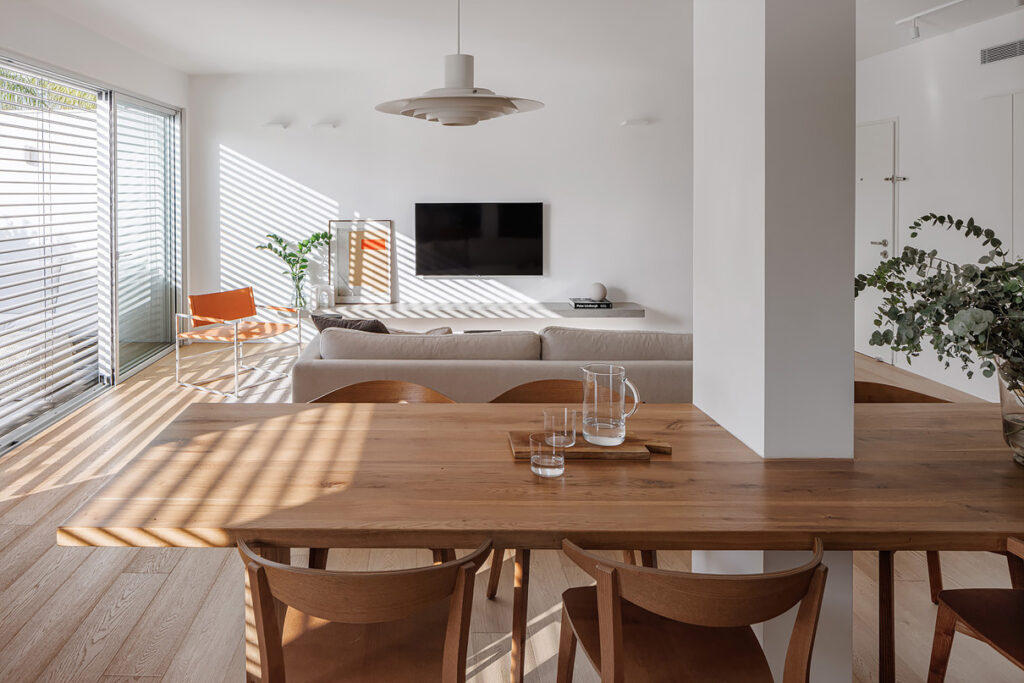
Apartment in Disinchik, Tel Aviv. Photo by Shai Epstein, Art by Tali Benbassat
But today life has changed, and modern design is so different, even compared to Bauhaus. So when you work on an old building — say, Bauhaus or even older — is your direction to preserve its history, to keep original elements?
Yes, very much so. I always begin by looking closely, opening the original architectural plans from the Tel Aviv archive, studying old photos, trying to understand how people once lived there. Nostalgia is powerful. It’s not about erasing but responding to what was. I often see it in my projects – in the walls, windows, or a single object that carries memory, like a piece from a grandmother’s home that moves with the family into a new high-end apartment.
Once, a client had as a bat mitzvah gift a small wooden cabinet of drawers filled with tiny perfume bottles. The apartment was modern, yet she insisted that the cabinet should stay as a dear memory. Listening to her story, I realized how much meaning it held. When you mix nostalgia with modernity, bringing something old into a new space, both transform — the new becomes more radiant, and the old gains new meaning.
It happened in my own home, too. We almost left behind an old piece of furniture, but at the last moment I said, “Let’s just take it — worst case, we’ll throw it out.” Once placed, it suddenly fit perfectly. The light, the space, everything changed, and it felt right.
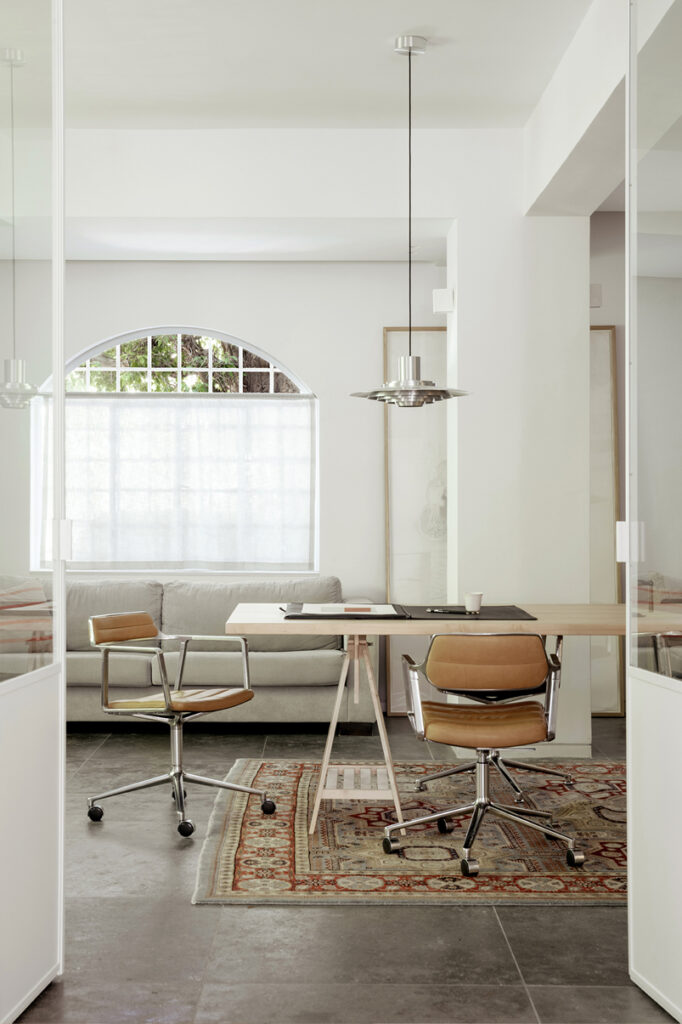
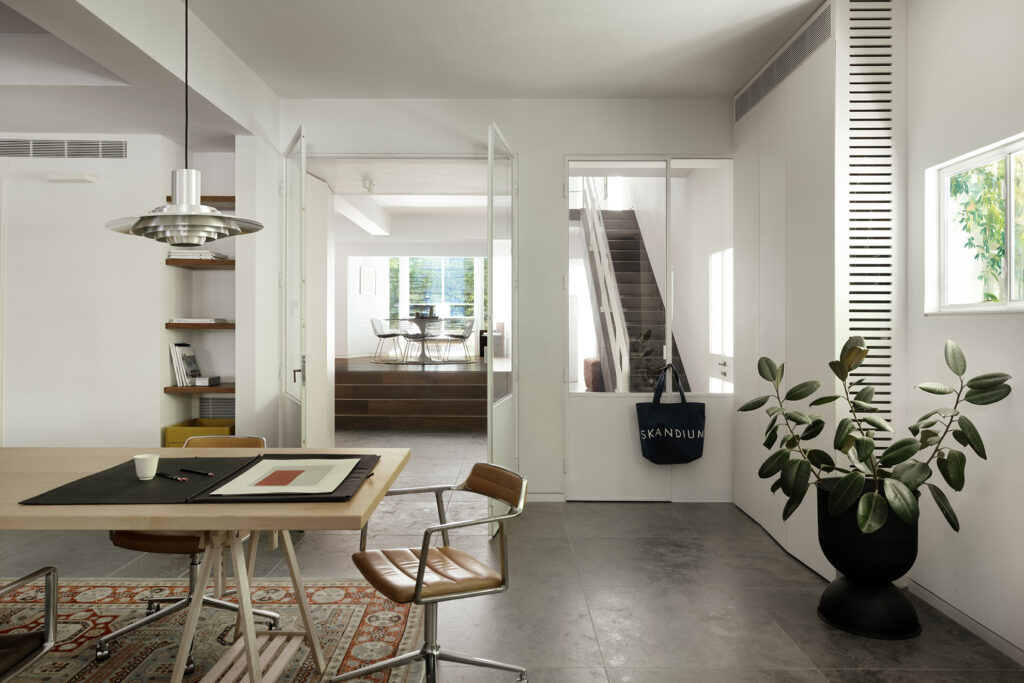
A private house, Tel Aviv. A joint project with AKA studio. Photo by Gidon Levin
How has your approach to architectural preservation evolved over time, and can you share a project where this process played a significant role?
At first, I dared to keep only small furniture pieces, but as I gained confidence, I began preserving larger architectural elements – a wall, a railing, even a floor. It’s something that develops naturally with time and experience.
In my most recent project, which is just being completed, preservation played a major role. The client initially worked with a very contemporary architect and came to me only for a consultation. The building, from the 1950s, had beautiful original architecture, and I told her: this project needs to preserve it. Her architect had ignored that character completely. I did hear from her for a while but just before the renovation began, she returned and chose to follow the preservation route. That project became a true balance between old and new – one of my most defining works. A dialogue between two worlds, and a process that always fascinates me: deciding what to keep, and what to renew.
And on a practical level, does this historical reference help you make design decisions?
Definitely. For example, in one project we needed to design a balcony railing. There were endless options – glass, metal, many variations. So I looked at what was originally used in the 1950s and realized that if this worked beautifully then why not to reinterpret it now? Not copy it exactly, but draw inspiration from it. So yes, the historical context often guides me. The furniture might be ultra-modern, bringing freshness and minimalism, but the architecture retains its authentic bones.
You work beautifully with vintage pieces. What is Israelis’ attitude to vintage today?
That’s a great question and there are so many answers. For some people, anything secondhand is a complete no-go. Others are curious and open to exploring. For me, vintage isn’t about secondhand – it’s about emotion. It’s about pieces that carry a story and evoke feeling. Sometimes it starts with wandering with clients or online. These days, much of that happens virtually: on Instagram, Facebook Marketplace, not necessarily in real markets.
Last week, I helped a client choose a dining-room light. We found a glass chandelier, not truly vintage, but great in character. However my client couldn’t connect to it. I reminded myself: it’s her home, not a photoshoot. Later we found a 1950s-inspired lamp – modern in form, vintage in spirit – and it just clicked. That’s what design is about: finding the right emotional balance.
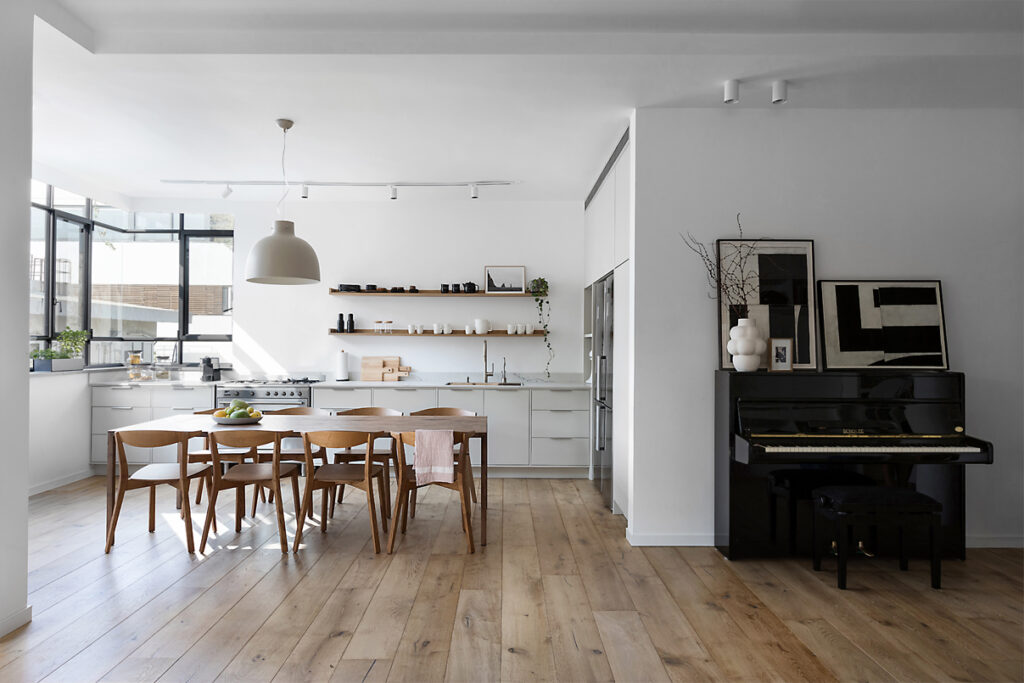
Apartment at the corner of Rotshild Blvd., Shenkin, Tel Aviv. Photo by Shiran Carmel
Do your clients usually ask for vintage pieces, or do you suggest them yourself?
It depends. In my presentations, I always include emotionally charged elements like vintage lighting. To me, light fixtures are like jewelry. They don’t commit you permanently, but they add emotion and character. So yes, sometimes it’s me, sometimes it’s the client. But anyone who chooses to work with me probably already has an instinct for that mix, a certain warmth and sensitivity. I’m not purely modernist. My architectural lines are modern, but there’s always softness and memory woven in.
And what’s your approach when combining vintage with modern elements? Do you have a formula — proportions, methods?
Interesting, I’ve never really analyzed it. But if I break it down, the architectural elements like built-in furniture are always modern.
I don’t try to fake vintage. I prefer clean, contemporary lines. But then I add freestanding vintage pieces. They bring character and story. Usually not many, but just enough to give soul. The walls and envelope remain modern, fitting our time. And you know, even the best carpenters today say it’s impossible to reproduce the old work. Old materials were far more durable than today’s. So preserving those older pieces is actually a smart decision as you can’t easily recreate them.
There is a project on your website with a lot of vintage furniture and lighting — even in the teenager’s room and the living area. It creates such a beautiful blend of modern life and vintage warmth.
You mean the Mena apartment. It was actually the first project I photographed professionally, and it became a real breakthrough for me. Some of the pieces there genuinely vintage finds from the Jaffa flea market, while others were new but crafted in a retro style by a local artisan named Yaniv who creates beautiful mid-century – inspired furniture. What’s funny is that the apartment itself was completely empty after the renovation and was waiting to be rented. But I was so eager to document it properly that I decided to “dress” it for the shoot. I brought in a truck full of furniture, borrowed pieces from shops, and styled everything myself. The client kindly agreed, and the result felt alive, as if someone already lived there.
Years later, a woman who had rented that same apartment reached out to me. She said, “I want you to design my new home — I loved that apartment so much.” Now she lives there with a grand piano standing in the exact same spot, and much of the original atmosphere still remains. One of my favorite details is the exposed brick wall. It had always been part of the building, but we cleaned it and turned it into the focal point of the living room. The same brick continues into the bathroom, creating a natural rhythm that ties the whole space together.
You often mention that you use local, original art. Have you had projects where an artwork was the starting point for the whole concept?
Yes, I do, because not everyone understands the value of original art. Many clients still choose posters or prints from IKEA or Etsy, and by the time we reach the art stage, the budget is usually gone. Even in projects with the biggest budgets.
There have been projects where art played a major role, especially when the client was a collector. But then the challenge comes: we need walls! Modern apartments are often all glass and built-ins, with nowhere to hang anything. So we actually created spaces designed specifically for art. In that project, the collection was international and Israeli art was just one part of it.
I haven’t yet had a project where a single artwork defined the entire design, but I did have that experience with a material. In one early project, my client had been sending me endless references, and I thought: let’s find one material to ground the whole concept. So I took her to a stone factory and she instantly fell in love with a particular stone, and everything else evolved from that choice.
What I do often do, especially when styling, is work with Israeli artists. There’s incredible talent here, and it’s important to support them. They’re always open to collaboration and the results are deeply rewarding.
And do Israeli clients respond well to local art?
Yes, absolutely. I’ll give you an example: in one project, we borrowed artworks just for the photoshoot, because the budget had run out. A few years later, as the client couldn’t stop thinking about one of those pieces, her husband went to the artist and bought it for her 40th birthday — the exact same work we used in the shoot. So sometimes it’s just a matter of timing and budget. But once you place an original artwork in someone’s home, they realize how powerful it is and often come back later to buy it. Art is deeply emotional and personal.
How do you choose the artworks for each project?
I usually take my client to the artist’s studio. I think meeting the artist is important, it creates connection. Sometimes you can look at a piece and feel nothing, but once you hear the story behind it, or meet the person who created it, it gains a completely new meaning.
Art carries energy: hours of creation, the emotion, the personal story behind it. So yes, I love taking clients to studios and often, they leave with a piece that truly speaks to them.
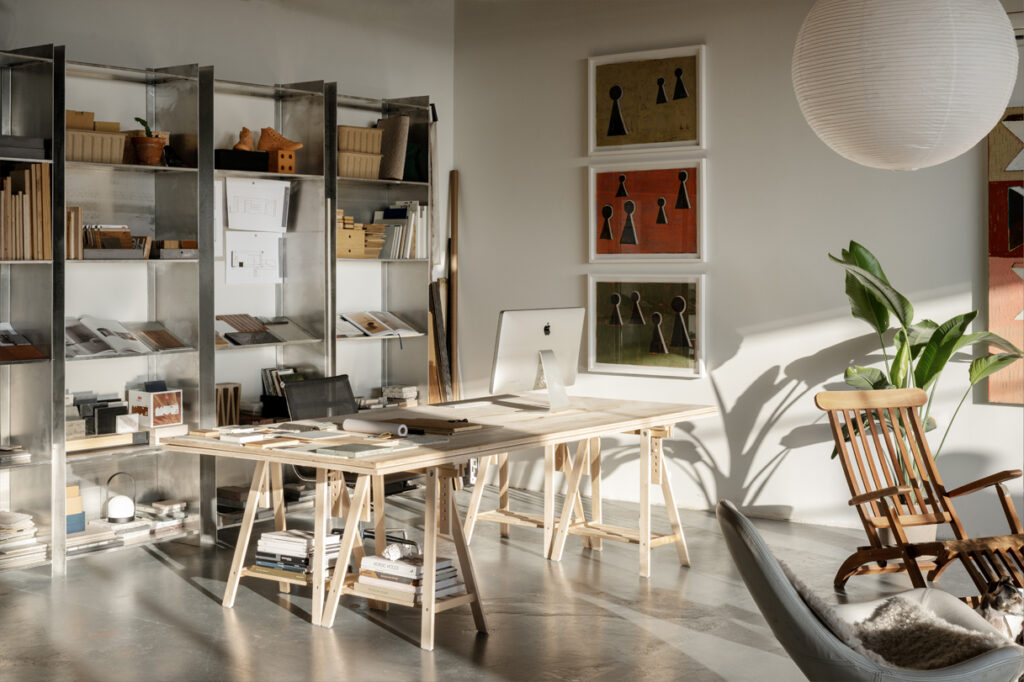
Studio by Yehuda Ben Yisha. A joint project with AKA studio. Photo by Gidon Levin
Let’s talk about materials. In almost every project you use wood, concrete, and natural stone. Are these your favorite materials? How do you choose materials for each project?
Material is something that really moves me, in a very physical sense. I love touching it, feeling it with my hands, even with bare feet. Sometimes I’ll literally press it to my cheek to sense its energy. Natural stone, for example, has existed for millions of years, it carries deep energy. Natural materials touch me emotionally. I connect less to industrial ones and even when I do use them, they have to retain an authentic feel.
Actually, one of the main reasons I opened my own studio was to have a proper materials library. Before that, I kept all my samples in closets at home, and it was chaos. Now clients can touch, compare, and experience everything. Usually, when a client visits, they’re drawn to one material and that becomes our starting point. For me, the default palette is often: stone, wood, and metal.
Concrete often enters the picture later, during site visits, when you suddenly discover something worth keeping. For example, in one project on Levontin Street, we hadn’t planned for concrete at all. But when we visited the site, I saw the raw concrete ceiling with the texture of the wooden formwork that looked like parquet! I asked the clients if they’d dare to keep it exposed, and they loved the idea. That ceiling ended up defining the entire project. If I hadn’t been open to seeing what was already there, it would have been plastered and painted over and we’d have lost something beautiful.
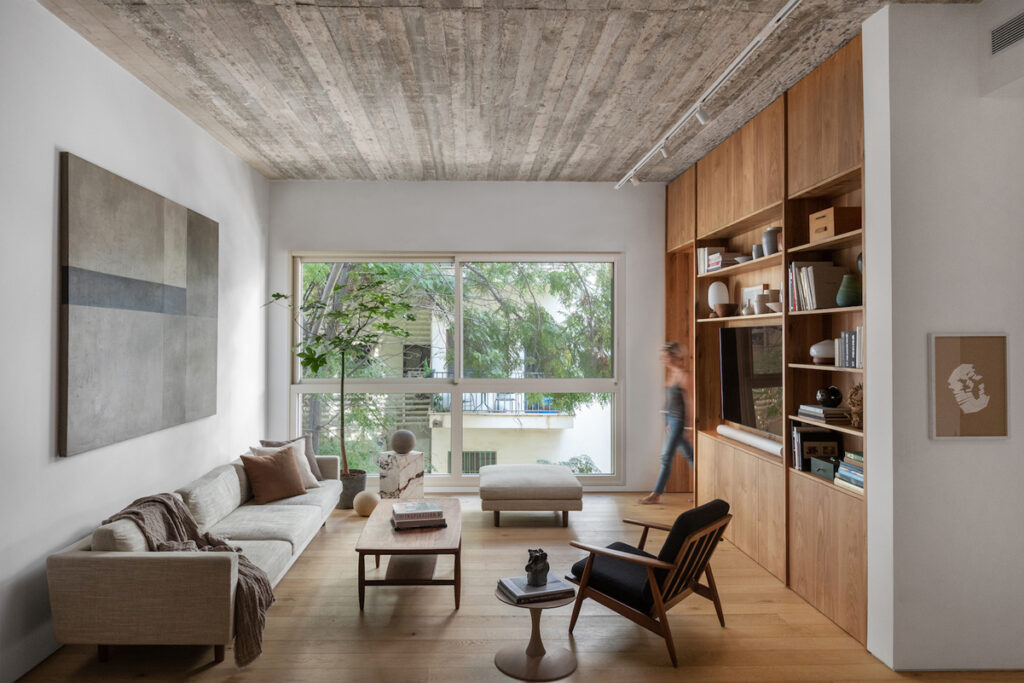
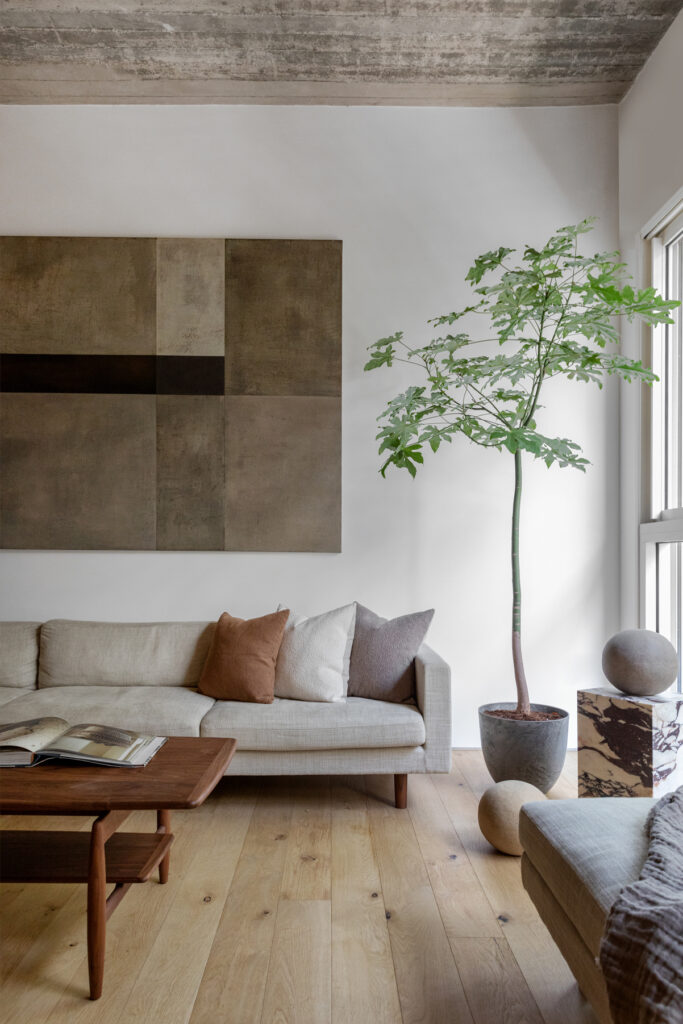
Apartment in Levontin, Tel Aviv. Photo by Shiran Carmel. Art by Orit Haviv
And what about your collaboration with carpenters? You work with a lot of custom-made furniture — how do you manage that process?
Yes, carpentry takes a huge amount of time. I spend many hours designing built-in pieces, often with hidden elements, secret doors, integrated details. It’s like a game. I love the moment when you open what looks like a wall, and it turns out to be a door, like Narnia!
These little surprises make a space fun, and in small apartments they’re also practical. Every project I do includes at least one custom carpentry element that’s unique and special. Over time, I’ve built long relationships with certain carpenters and we share a common language now. We communicate easily and correct each other. In the first years I didn’t have that confidence, but with experience you build trust. Now there’s often a parallel dialogue between me and the contractor or carpenter – a technical one that the client doesn’t even need to know about.
And do you have a dream project — one you’ve always wanted to do?
I think I’m doing it right now. It’s a very personal project, one that came to me in a strange, even magical way. About a year and a half ago, just before October 7, a client contacted me regarding an apartment near my home. I went to see it and immediately fell in love with the details, the architecture, the atmosphere. I thought everything should be preserved exactly as it was.
It turned out that the client’s mother had lived there for many years, and after she passed away, her daughter wanted to renovate it. We discussed it, I prepared a proposal, and then the war began. The client called me and said she’d decided to sell the apartment, so the project was canceled. Every morning, I walked with my dog past that building and looked at the apartment, thinking, I’m gonna design this place one day. Months later, a woman contacted me regarding an apartment on Chen Boulevard. I asked which building, and when she told me I have realized it was the same one! I couldn’t believe it. We met, had a wonderful conversation, but after I sent the proposal, she disappeared. Months passed. Then suddenly she called me again: “I hired another architect, but I still want you as a designer.” So eventually, she came back and now we’re finishing the project. This project in particular is a very special one for me.
So yes, I truly believe in the power of thought and intention! I knew I wanted this project, and somehow, it found its way back to me. I do have big dreams, but I keep them in a folder, waiting for the right time. And in the meantime, I focus on the smaller dreams – the ones that can already come true.
Amazing story! And finally, could you share a few personal design tips — small tricks you use in your projects?
- My first and most important tip: be present in the space. If it’s a renovation or a new construction, visit and feel it: walk around, open the windows, sense the air and light. The first material I bring into any home is air and sunlight. Understanding how light moves through the space often tells you exactly where the kitchen should be, or where the living room feels best. Sometimes the answer even comes from outside, like a tree you see through the window that suddenly defines a view. I often ask clients for a key so I can spend time alone in the apartment, just to experience it quietly. That intuition stays with me – even ten years later, I can still recall how a space felt. So that’s my biggest advice: listen to the space, to its energy.
- And second – connect people to materials. Because when clients touch, feel, and experience real materials, that’s when design starts to become personal. Photos aren’t enough, you need to open up their world, show them options, let them experience things with their own hands. That physical contact often creates the emotional connection to the material.
- There’s something else I find very important in the process – helping clients understand that nothing is ever perfect — and that’s what makes it beautiful.
No project is flawless. You can plan everything down to the last detail, and then the movers arrive and scratch the parquet! And that’s fine. That’s life. People themselves aren’t symmetrical. And just like people, spaces shouldn’t be perfect either. It’s important to convey that to clients: we aim for the best, the most thoughtful, but not for perfection.
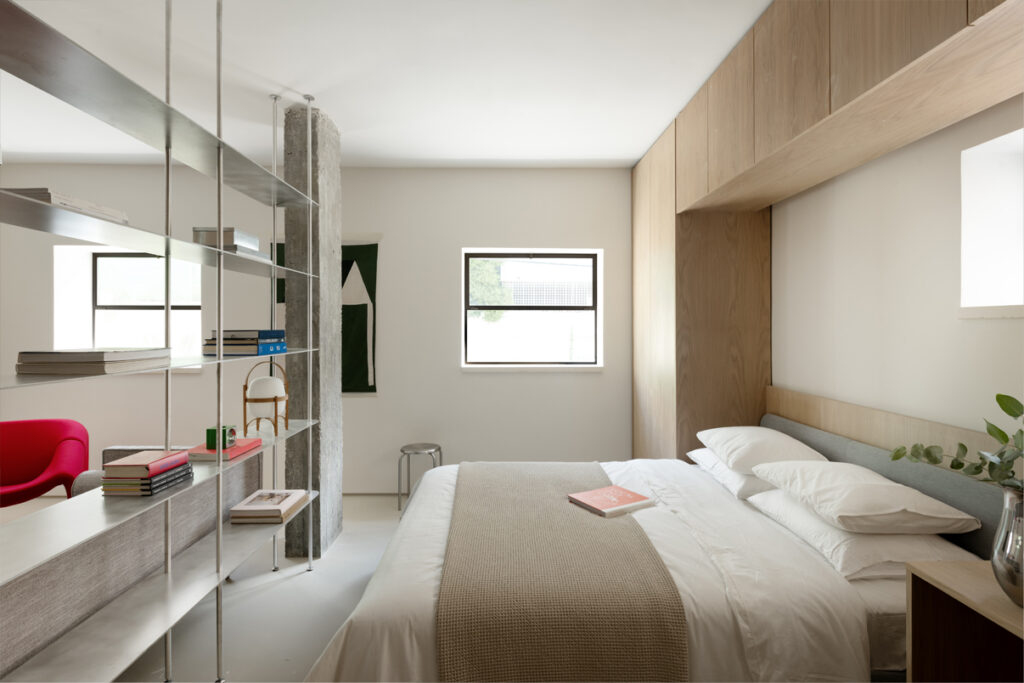
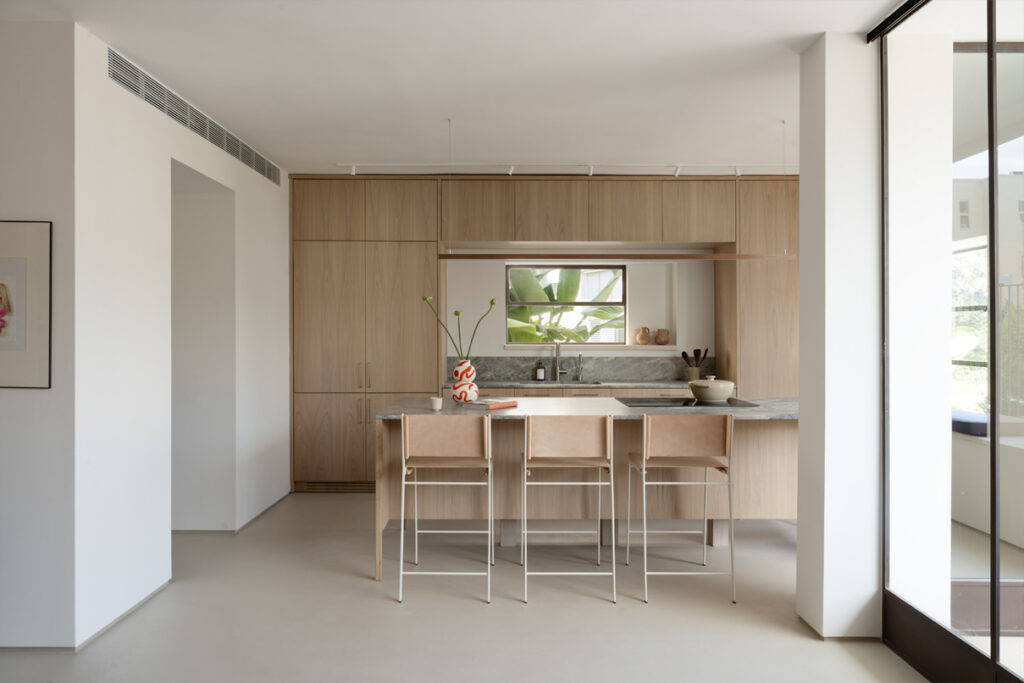
An urban vacation apartment 85 sqm, located in a building built in the 1970s in the center of Givatayim. Photo by Gidon Levin
Interview by Nadia Kraginskii and Olga Goldina for DI CATALOGUE
On the cover : a photo of the project of private house in Tel Aviv. A joint project with AKA Studio, Photo by Gidon Levin
Contacts: